Is in my neighborhood.
I think it is really awesome. Just look at the intricacy of some of the brickwork:
Doesn't it look so cool?? Did you know that you could do that with brick??? I sure didn't.
It really makes me want to know who built it, when and why.
Tell me how to say brick in Spanish, and I'll send you a postcard! Winner picked at random.
Showing posts with label Spanish. Show all posts
14 October 2010
10 October 2010
The Rain in Spain...
I think we all know how that one ends.
I'm not particularly well-versed on Spanish geography, although I do know that the Northwest is pretty cold, wet and gray (much like Oregon), and the South is very hot and dry (like Arizona). And there are several different miniature mountain ranges. And I think Madrid is situated on a high central plateau.
But this is what it looked like yesterday when I went into the center to wander around!
It was kind of pouring and I might have gotten a little soaked. Thank goodness for my paraguas! (First person to give its English translation in the comments gets a postcard from Madrid!)
I'm not particularly well-versed on Spanish geography, although I do know that the Northwest is pretty cold, wet and gray (much like Oregon), and the South is very hot and dry (like Arizona). And there are several different miniature mountain ranges. And I think Madrid is situated on a high central plateau.
But this is what it looked like yesterday when I went into the center to wander around!
It was kind of pouring and I might have gotten a little soaked. Thank goodness for my paraguas! (First person to give its English translation in the comments gets a postcard from Madrid!)
08 October 2010
María, Maríaaaaaa
My first week in Spain, someone (maybe a fellow student??) informed me that there was once a law in Spain that mandated that all female children had to be named María (as in, after the Virgen Mary).
Now, Franco might have gotten his crazy on for 35 years in this country, but that seemed a little far-fetched even for him. So clearly, I had to check it out, and by check it out, I mean ask my señora.
What I discovered is slightly more believable and only a little less ridiculous. See, when Franco ran the country, the Catholic Church also ran the country. They were kind of attached at the hip for a while in the early years, and part of that attachment meant that the Church could sort of you know, come up with the rules.
And one of the rules was that parents could only name their children after saints/religious figures/people in the Bible. And there are a whole lot fewer women than men in the Christian pantheon. And it was really really popular to name their girls María after the Virgen Mary. Not mandated, but close.
My señora's name is Maribel. That would be a conjunction of María Isabel. Her daughter's yorkie is called Pitu, but sometimes when she's frustrated with the dog, she calls her MariPitu. Because of the prevalence of María as a name in Spain.
Now, Franco might have gotten his crazy on for 35 years in this country, but that seemed a little far-fetched even for him. So clearly, I had to check it out, and by check it out, I mean ask my señora.
What I discovered is slightly more believable and only a little less ridiculous. See, when Franco ran the country, the Catholic Church also ran the country. They were kind of attached at the hip for a while in the early years, and part of that attachment meant that the Church could sort of you know, come up with the rules.
And one of the rules was that parents could only name their children after saints/religious figures/people in the Bible. And there are a whole lot fewer women than men in the Christian pantheon. And it was really really popular to name their girls María after the Virgen Mary. Not mandated, but close.
My señora's name is Maribel. That would be a conjunction of María Isabel. Her daughter's yorkie is called Pitu, but sometimes when she's frustrated with the dog, she calls her MariPitu. Because of the prevalence of María as a name in Spain.
30 September 2010
Being Legal
So I visited the police station today to finish up the process of getting my residency card. It was actually kind of a terrifying process, not because it was difficult or anything, but rather because Spain is incredibly bureaucratic.
According to people who live here, life is papers, papers, and more papers, and if you somehow need any sort of government document, you have to make sure that you have EVERY SINGLE form that you need, because if you're missing one, they will make you leave and not come back.
This was the penultimate step in a series of I-don't-know-how-many, and if I had forgotten something, it could have really delayed the process of getting my card, and could have potentially made me an illegal immigrant. Hence the terror.
However, all went well. They took my fingerprints and my pictures, along with the receipt for a fee that I paid on Tuesday and told me to come back in a month to retrieve my card. So now, I just have to wait.
According to people who live here, life is papers, papers, and more papers, and if you somehow need any sort of government document, you have to make sure that you have EVERY SINGLE form that you need, because if you're missing one, they will make you leave and not come back.
This was the penultimate step in a series of I-don't-know-how-many, and if I had forgotten something, it could have really delayed the process of getting my card, and could have potentially made me an illegal immigrant. Hence the terror.
However, all went well. They took my fingerprints and my pictures, along with the receipt for a fee that I paid on Tuesday and told me to come back in a month to retrieve my card. So now, I just have to wait.
24 September 2010
We Don't Need No Education!
- I would say that about 90% of Spanish children wear a uniform to school.
- They look really adorable, and yet it's also disconcerting.
- Until I remind myself of the Catholic history of this country's school system and then it makes much more sense.
- I'm living in a country where there is little difference between public and parochial schools.
- There are no school buses.
- Parents walk their children to school until they are old enough to walk it alone.
- It's really cute to watch this family time occur.
- Given the times that I see children walking to school and leaving, I would say that school starts every day between 9 and 9:30 and lets out somewhere between 2:30 and 3:30.
- Does that seem like a short school day to you? It does to me.
- In contrast, I have school four days a week.
- Does that seem like a short school week to you? It doesn't to me.
13 September 2010
La Biblioteca Nacional de España
For our first project for the Research Skills Workshop, we had to go to the National Library of Spain (which is actually quite close--just a few stops over on the metro), and get our library card and make some photocopies as proof that we were there.
Spain does not have open-stack browsing. This is a national travesty.
If I need to borrow a book, I cannot check it out. I have to fill out a little card with the book's call number and info, wait for them to bring it to me, and then take notes about it at the little desk that they have assigned me. I can make photocopies (maybe), but there is no way that the original copy is ever leaving the building. Just ask the security guards. They rifle through all of the papers that you bring with you when you enter the building and again when you leave, just to make sure that you don't try to sneak anything in or out.
I understand this entire procedure if I were trying to access ancient archives--or even relatively old archives, like from the '70s (kidding!). But the book that I looked at was published in 2010. So there's really no reason to keep it under lock and key.
I've just decided that I'm going to try to avoid researching there as much as possible this semester, since I don't really have much time to waste waiting for someone to find a book for me. It's a good thing that most of my papers this semester are based on class readings. And then, next semester, when I actually have to do research, I will have hopefully found more patience for bureaucracy.
Still, it's an awfully pretty library, isn't it?
12 September 2010
Classes
So I kind of love all of my classes this semester, and I will give you the run-down here:
Monday, 9:30 AM: Cultural History of Spain:
- Precisely the type of history that they don't let you study in school, since everyone is so obsessed with military/political history. I don't care about who won such and such battle or why. Just show me the pretty things they did to commemorate it.
Monday, 4-7PM: Research Skillz Workshop:
- This one is actually every other Monday, which is nice, and it's helping us adjust to a whole new library system (which is not nearly as warm and cozy as the library system in the States--Thank you Dewey Decimal and all library science majors everywhere!).
- No, they don't spell it with a 'z' in the syllabus, but I don't care. I see that it is gangster, and I am very gangster myself.
Tuesday, 9:30 AM: Cultural History of Latin America:
- Like a Cultural History of Spain, except in Latin America. Also, Syncretism!
- Syncretism is the combination of opposing beliefs. It generally refers to combining opposing religious beliefs, such as happened in the Spanish colonies with Christianity and the various indigenous religions--which led to awesome paintings of the baby Jesus dressed up like an Incan.
Tuesday, 11 AM: Cervantes:
- This class is potentially my favorite. Actually, I can already tell that it is my favorite. Why? Because we are reading Don Quijote (Parts I and II) in one semester and discussing. Also because Don Quijote is awesome. And because Cervantes was a genius. (He may have died bitter and alone, but that doesn't mean he wasn't a genius.) Also because Don Quijote is awesome.
- One aspect of the Quijote which is kind of important to understand is that, when DQ sets off into the world, he is only doing so to prove that the real world is the same as the world about which he had read in all of his fairy-tale novels. Does this sound familiar to you? Because it kind of sounds familiar to me...
Tuesday, 12:30 AM: Teaching Spanish as a Second Language:
- It was either this or textual criticism, and although all of the technical pedagogical language kind of terrifies me (I think I just used pedagogical and I'm not even sure I know what it means...), it's kind of a nice break from all of the literature. Also, I think it will be helpful.
Wednesday and Thursday just repeat Monday and Tuesday (minus the Research Skillz Workshop), and then Thursday evening, I come home and go to sleep.
11 September 2010
NYU in Madrid
The NYU in Madrid campus is two tiny houses (back-to-back) joined by a patio. Of course, the houses have been remodeled so that they serve quite well as offices and classrooms, but that doesn't mean that the space isn't pretty tight for the 100 or so people who are a part of this little expat community.
The patio is potentially my favorite place. I think that it is pretty much everyone's favorite place, since I can walk onto the patio and feel like I am back on a college campus (which is basically what it is). It's really quite a wonderful place to hang out, and I'm just sad that I won't be able to enjoy sitting out here all year 'round, since it actually gets cold in the winter in Madrid.
The graduate student welcome reception was potentially the most crowded that I have seen the patio. There were lots of hors d'oeuvres, tapas, and other delicious treats, and I think that at the moment I snapped this picture, one of the professors accidentally got her high heels wedged in the space between the teak slats. Whoopsies!
But perhaps my favorite thing about the patio is this little demi-roof, quite low to the ground, where this little puppy dog was resting one day. I think that captures what a patio is all about.
The patio is potentially my favorite place. I think that it is pretty much everyone's favorite place, since I can walk onto the patio and feel like I am back on a college campus (which is basically what it is). It's really quite a wonderful place to hang out, and I'm just sad that I won't be able to enjoy sitting out here all year 'round, since it actually gets cold in the winter in Madrid.
The graduate student welcome reception was potentially the most crowded that I have seen the patio. There were lots of hors d'oeuvres, tapas, and other delicious treats, and I think that at the moment I snapped this picture, one of the professors accidentally got her high heels wedged in the space between the teak slats. Whoopsies!
But perhaps my favorite thing about the patio is this little demi-roof, quite low to the ground, where this little puppy dog was resting one day. I think that captures what a patio is all about.
10 September 2010
NYU in Madrid...in Segovia
There are 24 people total in the NYU in Madrid Master's program--11 in the Lit. and Culture track and 13 in the translation track. Not all 11 of us were in Segovia, but of the 8 who were, here are 7:
Daniella, Me, Behnaz, Kaitlin, Kristin, Lindsey, and Mary Kate
08 September 2010
07 September 2010
SE-GO-VIA! (Part III)
I've kind of already talked about the Roman aqueduct, but I'm going to talk about it some more, because it is awesome.
2000 years old, built without mortar or concrete, and it's still going strong, transporting potable water into the city. Anymore, it doesn't transport enough water for the needs of the citizens, but still, it still works, and I think that's amazing. Also, according to the little bio that I have, this aqueduct has even survived earthquakes (though I'm not sure where the nearest fault line is), which is even more impressive in my book.
That picture up there is where the arches are at their tallest (≈30m). This is what it looks like when you're under an arch:
The rocks are really big, and the arches are really tall, and it's really pretty awe-inspiring. Did I mention that those stones at the top don't have anything holding them together but gravity? (gulp)
More pretty pictures!

That's what I love about Segovia. It's a pretty little Spanish city, and then BAM! Ancient Rome.
2000 years old, built without mortar or concrete, and it's still going strong, transporting potable water into the city. Anymore, it doesn't transport enough water for the needs of the citizens, but still, it still works, and I think that's amazing. Also, according to the little bio that I have, this aqueduct has even survived earthquakes (though I'm not sure where the nearest fault line is), which is even more impressive in my book.
That picture up there is where the arches are at their tallest (≈30m). This is what it looks like when you're under an arch:
The rocks are really big, and the arches are really tall, and it's really pretty awe-inspiring. Did I mention that those stones at the top don't have anything holding them together but gravity? (gulp)
More pretty pictures!
That's what I love about Segovia. It's a pretty little Spanish city, and then BAM! Ancient Rome.
06 September 2010
SE-GO-VIA! (Part II)
The alcazar (castle) in Segovia is super pretty. People say that Walt Disney based Cinderella Castle in Disney World on it, although I'm fairly positive that he probably based it on a combination of about 20 different castles from Europe, of which this is only one.
It's located on a high cliff between two rivers (perfect strategic location), so there's probably been a castle here from the beginning of time, but this specific one dates from the reign of Ferdinand and Isabel in the late 1400s -early 1500s.
Isabel was kind of a baller. Since she was the Queen of Castile, she entered her marriage with Ferdinand with a lot of power, and she made sure that he knew that. They may have been the King and Queen of Spain, but he was never the King of Castile, and when she died, he had to leave the region. You know, since he no longer had any power there. Her death had the potential to break up Spain.
Normally, queen's thrones are slightly smaller than their male counterparts, but Isabel made sure that their thrones were the exact same height...to reflect their equal power...because she was awesome.
And here are some more pretty pictures of the outside, because I think it is pretty:
04 September 2010
Madrid de los Austrias
The one thing that I love about the NYU program is that we do lots of group 'study' activities, like a walk through the really old part of Madrid, los Austrias. They call it los Austrias because the kings responsible for its creation were from the House of Austria.
This is the Plaza de Villa (the plaza of the town), and the big building on the right housed the mayor's offices (or perhaps housed the mayor, I can't remember).
This statue of King Felipe IV was one of the first equestrian statues where the horse is balancing on only 2 legs. Apparently Galileo came up with the way to balance out the density of the statue so that it worked and is still standing over 150 years later.
And this is just a little view down a little alley towards a monastery, with some huge new modern building in the background. Spain juxtaposes the modern and the antique quite often, so there will probably be lots of pictures like this because I find the contrast interesting.
29 August 2010
Madrid
I'm here! I've arrived (quite safely, too, I might add)! And the city hasn't changed a bit since I was here last (2008, for those keeping track). It's still hotter 'n snot and the streets a dirty and dust-filled (even though individual people mop the sidewalks outside of their shops/apartment buildings, they never seem to really get clean...probably because someone almost immediately tosses down a cigarette or a used metro card).
I've mostly been recovering from jetlag (hey--it takes me awhile, ok?). But I have managed to visit some of my favorite places (and eat some of my favorite foods)!
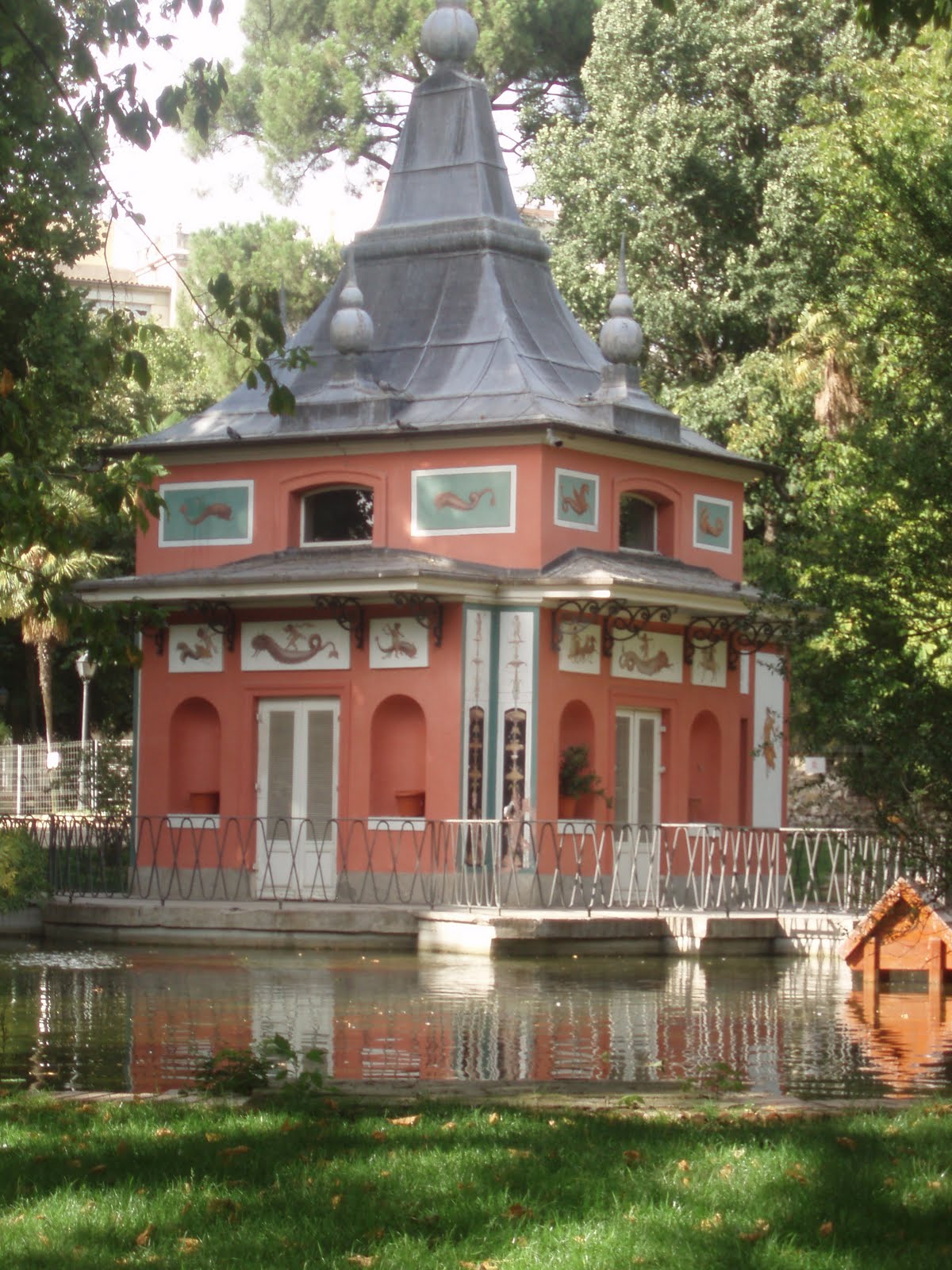
For instance, pictured below is the Casa del Pescador (The House of the Fisherman) in the Parque del Retiro (from now on, it's just the Retiro). The Retiro was just one of the many places where former kings of Spain would go to hunt/fish/kill things for fun. Fernando VII was one of these kings, and within the park, he built lots of cute little hunting lodges, such as this one, intended for fishing:
The Retiro is absolutely my favorite place of all of Madrid. It's like Central Park, but better, because there are more even more walking paths and it's quieter.
It's also near a bunch of little shops and restaurants, like La Taberna del Toro, the restaurant in which I ate what is one of my favorite meals in Spain: Gazpacho and Calamari.
I've mostly been recovering from jetlag (hey--it takes me awhile, ok?). But I have managed to visit some of my favorite places (and eat some of my favorite foods)!
For instance, pictured below is the Casa del Pescador (The House of the Fisherman) in the Parque del Retiro (from now on, it's just the Retiro). The Retiro was just one of the many places where former kings of Spain would go to hunt/fish/kill things for fun. Fernando VII was one of these kings, and within the park, he built lots of cute little hunting lodges, such as this one, intended for fishing:
The Retiro is absolutely my favorite place of all of Madrid. It's like Central Park, but better, because there are more even more walking paths and it's quieter.
It's also near a bunch of little shops and restaurants, like La Taberna del Toro, the restaurant in which I ate what is one of my favorite meals in Spain: Gazpacho and Calamari.
Don't they look just absolutely delicious?
06 August 2010
05 August 2010
Zorro (III)/Telenovela
Christian Meier as Don Diego de la Vega
http://www.zorro.com/news-znov.html
2008--Telemundo--Telenovela--Beyonce Theme--Priceless!
Now if it would only come out on DVD.
04 August 2010
02 August 2010
01 August 2010
Subscribe to:
Posts (Atom)